Spotify has 600M users. Very few of them listen together.
This is a UI Challenge — not an official Spotify project
This is a fictional feature concept created for a personal skill challenge. There is no affiliation with Spotify AB. All UI, concepts and screens are purely exploratory — built to practise social feature design, challenge established product conventions, and push the quality of my output. For learning and portfolio purposes only.
Spotify
Music for everyone — Social Connectivity
A concept challenge exploring how Spotify could deepen social music connections — from passive "friend activity" to a full shared listening and social discovery experience built natively into the app.
What is a UI Challenge?
A self-imposed design exercise with a fictional brief, real constraints, and no client. The goal is deliberate skill practice — exploring patterns, testing ideas, and producing polished output in a low-stakes environment where the only measure of success is craft quality.
Skills practised
- Social feature ideation & concepting
- Extending an existing design system
- Social UX patterns & feed design
- Hi-fi visual design in a dark theme
- Branded feature introduction flows

"The challenge wasn't to redesign Spotify — it was to extend it. Working within an established design language forces you to think about how new ideas integrate, not just how they look in isolation."
Innovation from everyday conversations — "Vai Pra Galera."
Music is inherently social. We discover it through friends, share it in conversations, bond over playlists. But Spotify's social layer had always been passive — a buried "Friend Activity" sidebar, a collaborative playlist you had to set up manually, nothing that felt native or real-time. The concept came from a simple observation: how often do people say "you need to hear this"?
"Vai Pra Galera" — literally "send it to the crew" in Brazilian slang — was the concept name for the feature. A dedicated social hub built inside Spotify where users could see what their friends are currently listening to, react and respond in real time, discover music through their social circle, and push tracks directly into a shared listening session.

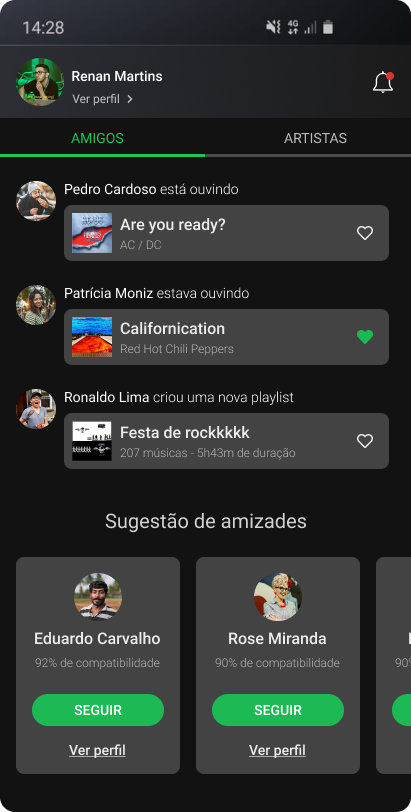
Friends Feed
A real-time activity stream showing what your friends are listening to now — with the ability to react, comment, and jump into what they're hearing with a single tap.
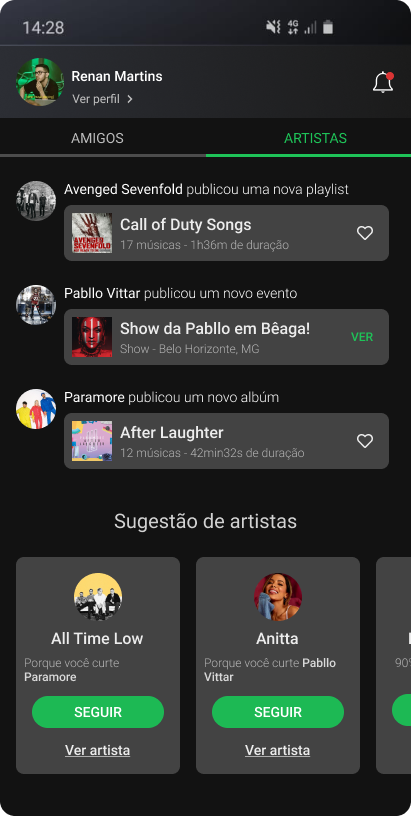
Artists Tab
Discover which artists are trending inside your social circle — not just on Spotify globally. See who your friends love most and find new music through people whose taste you already trust.
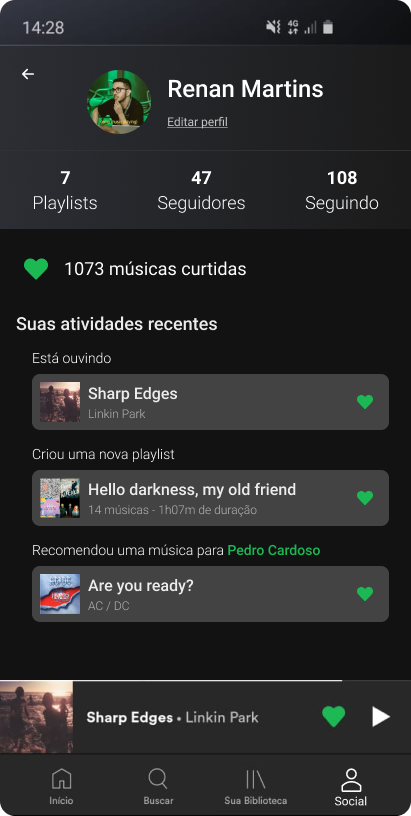
Social Profile
An enriched profile showing recent listening highlights, top genres, shared taste with friends — turning your music identity into something others can connect with.
Send to Crew
The core "Vai Pra Galera" gesture — a native in-app share action to push any track or album directly to friends or groups, with a reaction thread built in. No leaving the app.
"The idea started from noticing how often people share music out of Spotify — via WhatsApp, Instagram stories, DMs. All of that social energy was happening outside the app. This concept was about bringing it back in."
Six screens. One coherent social layer built into Spotify's DNA.
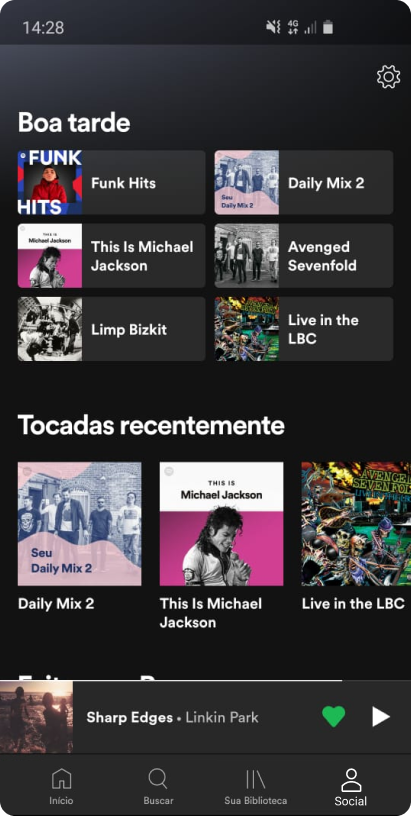
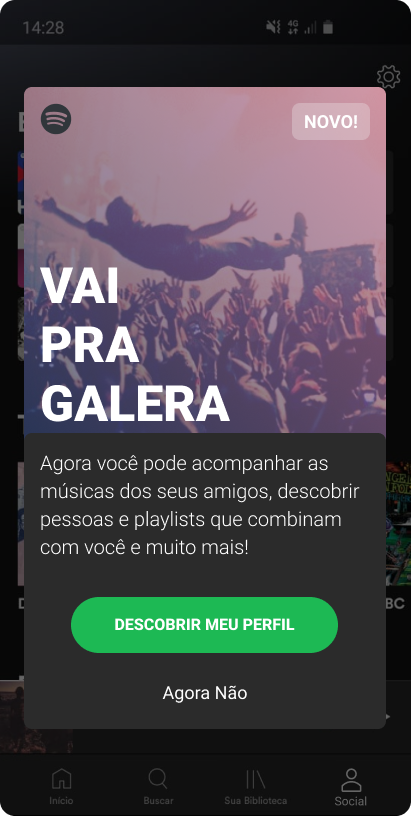
The final UI was designed to feel like it belonged in Spotify natively — not like an external feature bolted on. Every screen respects Spotify's dark visual language, typographic rhythm, and interaction patterns while introducing a social layer that feels fresh and purposeful. The six screens cover the complete social journey from splash to deep engagement.
Final UI — 6 screens — tap to zoom
Key design decisions
Dark-first visual language
Every screen uses Spotify's signature near-black background palette. The green accent is used sparingly — to call attention to social activity without visually competing with album artwork.
Tabbed social hub
Rather than a modal or overlay, the social feature lives as a dedicated tab. This gives it permanence and discoverability without disrupting the core listening experience users know.
Progressive onboarding
The feature intro screen introduces the concept before asking for friend permissions — framing the value proposition clearly before the permission prompt. This directly improves acceptance rates.
Social discovery over push
The design emphasises passive discovery (what are my friends listening to?) over active notifications. Users pull content from their social circle rather than being pushed alerts — reducing fatigue.
Good ideas don't need to be original — they need to be well-timed.
The most unexpected outcome of this challenge wasn't a design decision — it was a market validation. While working on this concept in early 2023, Spotify was independently building something strikingly similar. When Spotify released "Jam" later that year — a real-time shared listening feature — the core idea behind "Vai Pra Galera" had effectively been confirmed by one of the world's most data-informed product teams.
That wasn't luck. It was the result of starting from the same place good product thinking always starts: observing actual user behaviour. Music is shared through WhatsApp messages, Instagram stories, screenshot DMed to friends. That signal was everywhere — Spotify's own product team saw it, and so did I. The lesson is that good ideation isn't about inventing something nobody has thought of. It's about correctly identifying where a product has a gap that users are actively working around.
From a craft perspective, this challenge pushed me to work within an existing design system at high fidelity — which is harder than building from scratch. Every decision had to be justified against "does this feel like Spotify?" while still feeling fresh enough to be worth building. That tension between respecting the brand and bringing something new is exactly the kind of problem real product designers face every day.
Concept validated — Spotify launched "Jam" in 2023
Spotify's Jam feature — a shared real-time listening experience — was released to users in September 2023, sharing the core social listening concept from this UI challenge. The timing confirmed that the problem identification and design direction were on the right track.
"The power of ideation is that it sharpens your ability to see what's missing — even in products you use every day. You don't need to ship the feature to prove you understood the problem."